Iguazu Falls are located where the Iguazu River tumbles over the edge of the Paraná Plateau, 23 kilometres (14 mi) upriver from the Iguazu's confluence with the Paraná River. Numerous islands along the 2.7-kilometre-long (1.7 mi) edge divide the falls into many separate waterfalls and cataracts, varying between 60 to 82 metres (197 to 269 ft) high. The number of these smaller waterfalls fluctuates from 150 to 300, depending on the water level. Approximately half of the river's flow falls into a long and narrow chasm called the Devil's Throat (Garganta del Diablo in Spanish or Garganta do Diabo in Portuguese). The Devil's Throat is U-shaped, 82 metres high, 150 m wide, and 700 m long (269×492×2,297 ft). Placenames have been given also to many other smaller falls, such as San Martín Falls, Bossetti Falls, and many others.
Showing posts with label Brazil. Show all posts
Iguazu Falls, Brazil & Argentina...
Iguazu Falls, Iguazú Falls, Iguassu Falls, or Iguaçu Falls (Spanish: Cataratas del Iguazú [kataˈɾatas ðel iɣwaˈsu]; Guarani: Chororo Yguasu [ɕoɾoɾo ɨɣʷasu]; Portuguese: Cataratas do Iguaçu [kataˈɾatɐʒ du iɡwaˈsu]) are waterfalls of the Iguazu River on the border of the Argentine province of Misiones and the Brazilian state of Paraná. The falls divide the river into the upper and lower Iguazu. The Iguazu River rises near the city of Curitiba. For most of its course, the river flows through Brazil, however, most of the falls are on the Argentine side. Below its confluence with the San Antonio River, the Iguazu River forms the boundary between Argentina and Brazil.
Iguazu Falls are located where the Iguazu River tumbles over the edge of the Paraná Plateau, 23 kilometres (14 mi) upriver from the Iguazu's confluence with the Paraná River. Numerous islands along the 2.7-kilometre-long (1.7 mi) edge divide the falls into many separate waterfalls and cataracts, varying between 60 to 82 metres (197 to 269 ft) high. The number of these smaller waterfalls fluctuates from 150 to 300, depending on the water level. Approximately half of the river's flow falls into a long and narrow chasm called the Devil's Throat (Garganta del Diablo in Spanish or Garganta do Diabo in Portuguese). The Devil's Throat is U-shaped, 82 metres high, 150 m wide, and 700 m long (269×492×2,297 ft). Placenames have been given also to many other smaller falls, such as San Martín Falls, Bossetti Falls, and many others.
Arena da Amazonia, Amazon Arena, Manaus, Amazonas, Brazil...
Arena da Amazônia (Amazon Arena) is the name of a football stadium in Manaus, Amazonas, Brazil, located on the former site of the Vivaldão stadium. The stadium has an all-seater capacity of 46,000 and was constructed from 2010 to December 2013. It will host matches of the 2014 FIFA World Cup.
2013
Estádio do Morumbi, São Paulo, Brazil...
The Estádio Cícero Pompeu de Toledo, widely known as Morumbi, is a football stadium located in the Morumbi district in São Paulo, Brazil. It is the home of São Paulo Futebol Clube and its formal name honors Cícero Pompeu de Toledo, who was São Paulo Futebol Clube's chairman during most of the stadium construction and died before its inauguration. Morumbi is the largest privately owned stadium in Brazil. The stadium was designed by the architect João Batista Vilanova Artigas.
Hotels
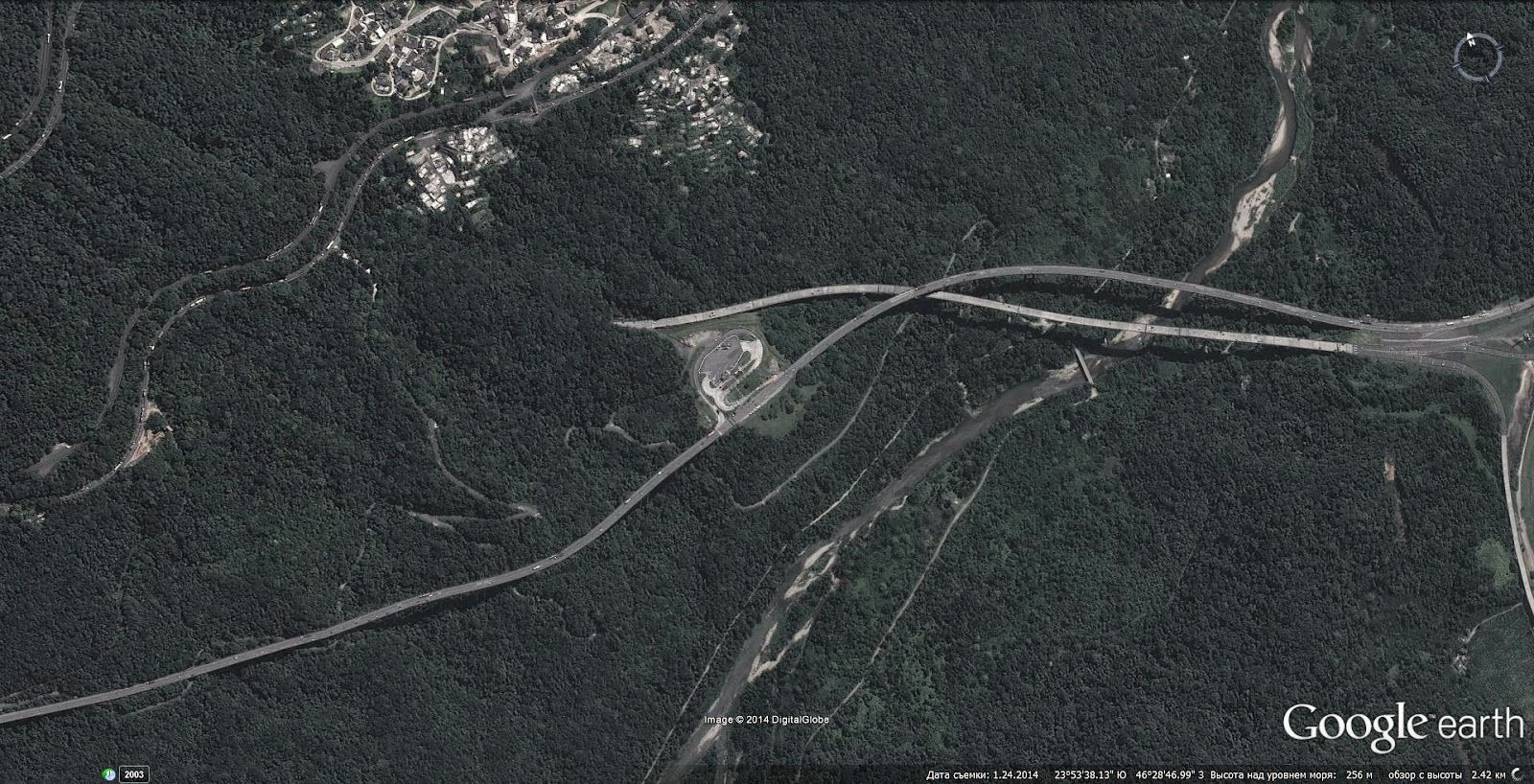
Rodovia dos Imigrantes (SP‑160), São Paulo (state), Brazil...
Rodovia dos Imigrantes (official designation SP‑160) is a highway in the state of São Paulo, Brazil. The highway connects the city of São Paulo to the Atlantic coast and with the seaside cities of São Vicente and Praia Grande. It follows the route of Rodovia Anchieta and is also one of Brazil's busiest highways, especially on weekends.
Rodovia dos Imigrantes has 44 viaducts, 7 bridges, and 11 tunnels, along its 58.5 km stretch. The highway has recently been expanded, in one of the most audacious feats of Brazilian highway engineering, with extremely long tunnels and high strutting six-lane bridges constructed over the tropical rain forest which covers the steep faces of the Serra do Mar, the cliff range that separates the São Paulo plateau from the seaside lowlands. During sunny weekends, more than 1 million automobiles commonly cross its near 60 km run, separating the city of São Paulo from the sea.
Rodovia dos Imigrantes was inaugurated in 1974, due to traffic saturation on Rodovia Anchieta. Although longer than Anchieta, Rodovia dos Imigrantes is nowadays busier due to its building standards, which permit higher speed limits, and its more direct path to the cities of Santos and Guarujá, the northern coast (with Bertioga), as well as the southern coast (with cities Praia Grande, Mongaguá, and Itanhaém.
Meaning "immigrants' highway" in Portuguese, Rodovia dos Imigrantes was so named as a way to remember the contribution of immigrants to the cultural, economic, and social development of Brazil.
It is managed by a state concession to the private company, Ecovias, which also maintains Rodovia Anchieta; it is, therefore, a toll road.
The two carriageways of Rodovia dos Imigrantes are both fully reversible and traffic is managed to flow either bidirectionally (uphill on one carriageway and downhill on the other) or unidirectionally (uphill or downhill on both carriageways), depending on demand. In the unidirectional mode, the opposing traffic is diverted to Rodovia Anchieta.
Hotels
Christ the Redeemer...
Ярлыки:
Brazil,
Christ the Redeemer,
Corcovado,
mountain,
Rio,
Rio de Janeiro,
Santa Teresa,
statue
Place -
Christ the Redeemer